Logging in, trading, and verifying on OKX: a practical comparison for US-based traders
- 10 de dezembro de 2025
Imagine you wake up to a sharp price move in BTC and want to act: enter a spot buy to hold, open a futures short for hedging, or move quickly between chains from your Web3 wallet. Which OKX entry point do you use, what steps protect your account, and what trade-offs should shape your decision in a US context? This article walks through OKX spot trading, OKX futures, and the platform’s verification/login mechanics with the single aim of turning confusion into a usable mental model you can apply the next time liquidity, leverage, or compliance matter.
I’ll steer toward mechanisms (how each service actually works), practical trade-offs (speed vs. safety; leverage vs. liquidation risk; custodial convenience vs. non-custodial control), and limits you must respect. I also include one concrete operational link to the official login path that many US traders will use to access the platform securely.
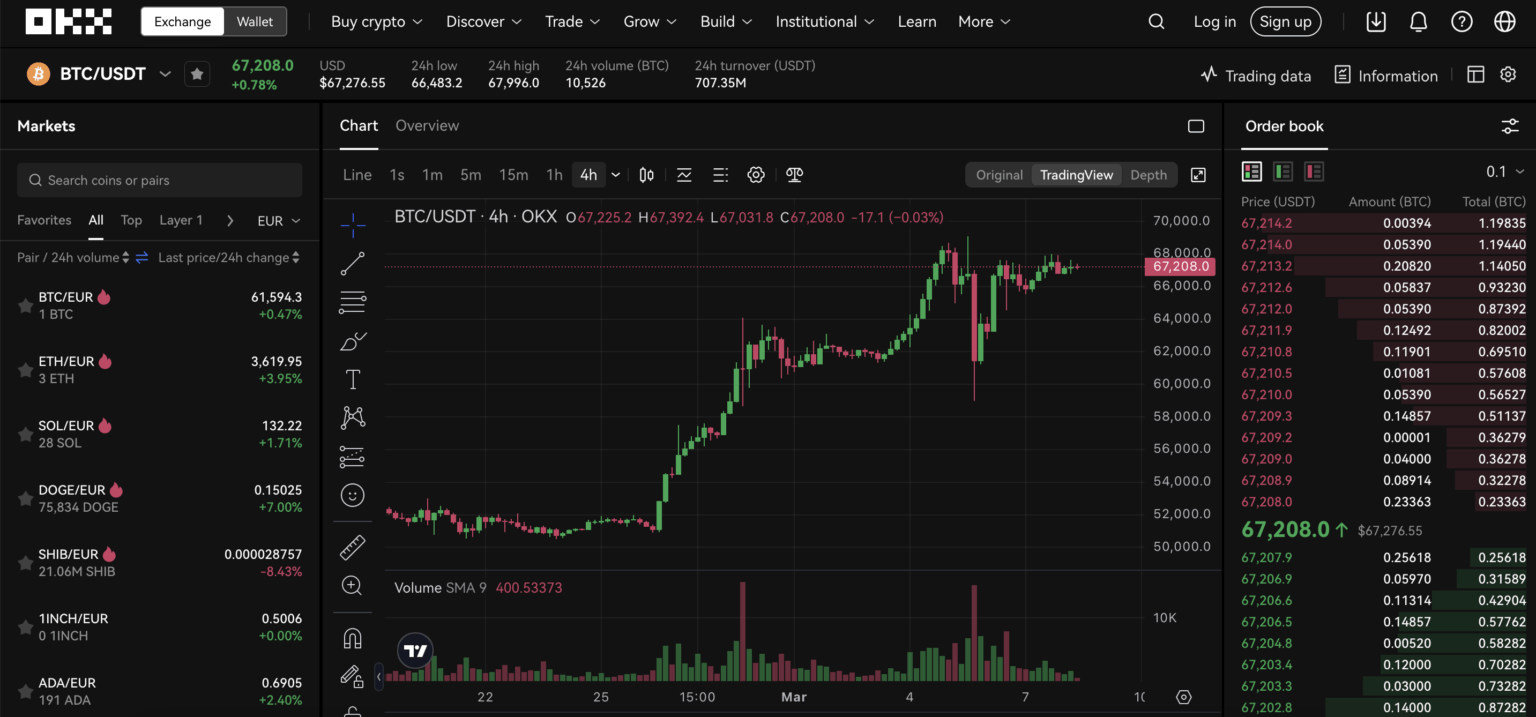
How OKX spot trading works — mechanisms and practical limits
Spot trading on OKX is the straightforward exchange of one token for another at the current market price. Mechanically, you place a market, limit, or conditional order on the centralized order book. The platform matches your order against displayed bids and asks; for most high-liquidity pairs (BTC, ETH, major stablecoins) execution is quick and slippage low. But problems emerge for thinly traded tokens: wide bid-ask spreads, depth holes, and slippage during fast moves. The exchange recently delisted several low-activity spot pairs (RSS3, MemeFi, GHST, RIO, SWEAT), which is exactly the kind of pruning that reduces cancellation risk and stale orderbook fragmentation—and a reminder that availability changes over time.
Two practical limits matter. First, withdrawal and custody. OKX reports >95% cold storage for custodial assets using multi-signature offline wallets; that reduces exchange-side hacking risk but does not eliminate account-level threats like phishing. Second, regulatory and asset listing risk: routine delistings change your ability to trade or hold certain tokens on the CEX. If you plan to hold unusual tokens long-term, consider whether the exchange’s delisting policy and Proof of Reserves transparency meet your tolerance.
OKX futures: leverage, mechanics, and risk management
Futures and perpetual swaps on OKX let traders take synthetically larger positions than their cash balance would permit. Mechanically, a futures position is precisely an agreement to buy or sell an asset at a later time (quarterly contracts) or to maintain exposure without expiry (perpetual). OKX supports options, quarterly futures, and perpetuals with leverage up to 125x on some instruments. That headline leverage is attractive but dangerous: higher leverage compresses the margin buffer and increases the speed at which liquidations occur. Margin modes (isolated vs. cross) let you choose whether the position’s margin is ring-fenced or pooled across positions—each has clear trade-offs.
If you use isolated margin, a single position blows up without touching other balances; that limits contagion risk but forces active margin management. Cross margin reduces liquidation probability across multiple positions but exposes more of your account to a single adverse move. Another key mechanism is funding rates for perpetuals: these payments between longs and shorts keep the perpetual price near the spot index. Funding can be a predictable carry cost or income—don’t ignore it in multi-day trades.
Verification and secure login: what US traders need to know
To create and operate an OKX account you must complete Know Your Customer (KYC) verification: government-issued ID plus a liveness facial check. This is a compliance requirement (AML) that has two practical consequences for US users. First, limits on anonymity—if you need privacy for legal reasons, a centralized exchange is the wrong tool. Second, KYC allows higher withdrawal limits and access to products like margin and futures. The verification process reduces certain fraud vectors but introduces new ones: incorrect uploads can stall access, and personal data increases the stakes of any platform breach.
Login protection layers include mandatory two-factor authentication (SMS or Google Authenticator), biometric options on mobile apps, and AI-driven real-time threat detection for suspicious logins. For many US traders, the best practice is to enable hardware-based 2FA (where supported) or a time-based authenticator app and to register device biometrics for convenience without sacrificing security. If you prefer self-custody for long-term holdings, OKX also provides a non-custodial Web3 wallet with seed phrases and hardware wallet integrations; that separates trading balances on the CEX from assets you control directly.
When you’re ready to access the platform, use the official login route to avoid phishing sites; one helpful starting point is this OKX login page: okx login.
Spot vs. Futures: a side-by-side decision framework
Here’s a compact decision heuristic you can use at the desk. Choose spot when your primary objective is ownership (long-term holding), simple market exposure, or avoiding funding costs. Choose margin/isolated-leverage for tactical, size-limited plays where you can watch the position closely. Choose cross-margin only if you understand correlated risks across positions and can accept broader exposure to liquidation. Choose futures/perpetuals when you need precise directional exposure, the ability to short easily, or leverage for hedging; but size positions conservatively and use stop-losses and maintenance-margin monitoring automatically when possible.
A common misconception is “leverage magnifies returns and is therefore always better.” Reality: leverage magnifies both gains and losses and shortens the time horizon over which recoveries are possible. With 125x, a tiny move against you can liquidate the position; with 5–10x, you retain more time and margin flexibility. Treat high leverage as a tool for experienced, disciplined traders, not as a shortcut to returns.
Where the system breaks: limits, non-obvious risks, and boundary conditions
Several boundary conditions deserve emphasis. Liquidity dries up first in low-cap pairs—this affects both spot and futures (basis blowouts). Slippage is not purely a market concept; it interacts with exchange order-matching algorithms and timeout settings. Smart-contract and DeFi risks arise when you bridge assets off-platform via the DEX aggregator or Web3 wallet: OKX’s DEX sources liquidity across Uniswap and others, but cross-chain bridges add counterparty and smart-contract risk that custodial storage avoids.
Another limit is jurisdictional. US regulatory scrutiny of certain derivatives, token listings, and custody arrangements can change product availability quickly; delistings are a mundane example. Expect product sets to shift and keep an exit plan if you trade exotic tokens. Finally, 2FA and cold storage mitigate, but do not remove, phishing and social-engineering risk: attackers focus on the human link, and any compromise of recovery email, authenticator seed, or device can be decisive.
Practical routines: a usable checklist before you trade
1) Verify KYC and set hardware or app 2FA; avoid SMS-only where possible. 2) Separate funds: keep trading capital on the exchange, long-term holdings in hardware or the non-custodial wallet. 3) Use small initial position sizes for new strategies; scale only with clear, repeatable edge. 4) Monitor funding rates and open interest for futures to detect crowded trades. 5) Watch orderbook depth and recent delistings for the assets you trade; if a token’s pair was recently delisted elsewhere, its liquidity can evaporate fast.
These are simple rules, but they map directly onto the mechanisms that cause most avoidable losses: margin calls, slippage, and fraud.
What to watch next — conditional signals, not predictions
Three conditional signals matter. First, product availability: more regulatory friction in the US could continue to shift which contracts or assets are accessible. Second, liquidity concentration: increases in large retail activity or concentrated institutional positions will show up as higher open interest and wider spreads—track these as leading risk indicators. Third, cross-chain adoption: if aggregated DEX routing and bridges deliver reliably lower costs, some volume will move away from centralized spot markets; but that shift depends on smart-contract security improving and user experience staying frictionless.
FAQ
Do I need KYC to use OKX for spot and futures?
Yes. KYC (government ID plus a facial liveness check) is required for account creation and access to margin/futures products. Verification expands limits and product access but reduces anonymity—an expected trade-off under AML rules.
Is it safer to trade spot or futures on OKX?
Neither is inherently safer; the risks differ. Spot trading reduces liquidation risk because you own the asset outright, but you face custody and delisting risk. Futures magnify market risk through leverage and require active margin management. Safety comes from position sizing, using appropriate margin modes, and strong account security.
What are the limits of OKX cold storage and Proof of Reserves?
Cold storage and multi-sig reduce exchange-side theft risk, and Proof of Reserves increases transparency about backing ratios. However, they don’t protect against account-level compromise, phishing, or regulatory-imposed freezes. Treat them as risk-reduction measures, not absolute guarantees.
How should a US trader think about leverage caps like 125x?
High leverage exists but is typically suitable only for short-duration, highly disciplined trades. Use smaller leverage and set pre-defined stop-losses. The practical rule: higher leverage requires faster reaction and stricter risk controls.
Decision-useful takeaway: match the product to the question. Use spot when you want ownership and simplicity; use futures for hedging or directional bets when you accept the maintenance and liquidation mechanics. Layer strong KYC, 2FA, and custody choices onto that decision and monitor liquidity and regulatory signals—those are the mechanisms that will decide whether your trade is executed cleanly or becomes an avoidable loss.